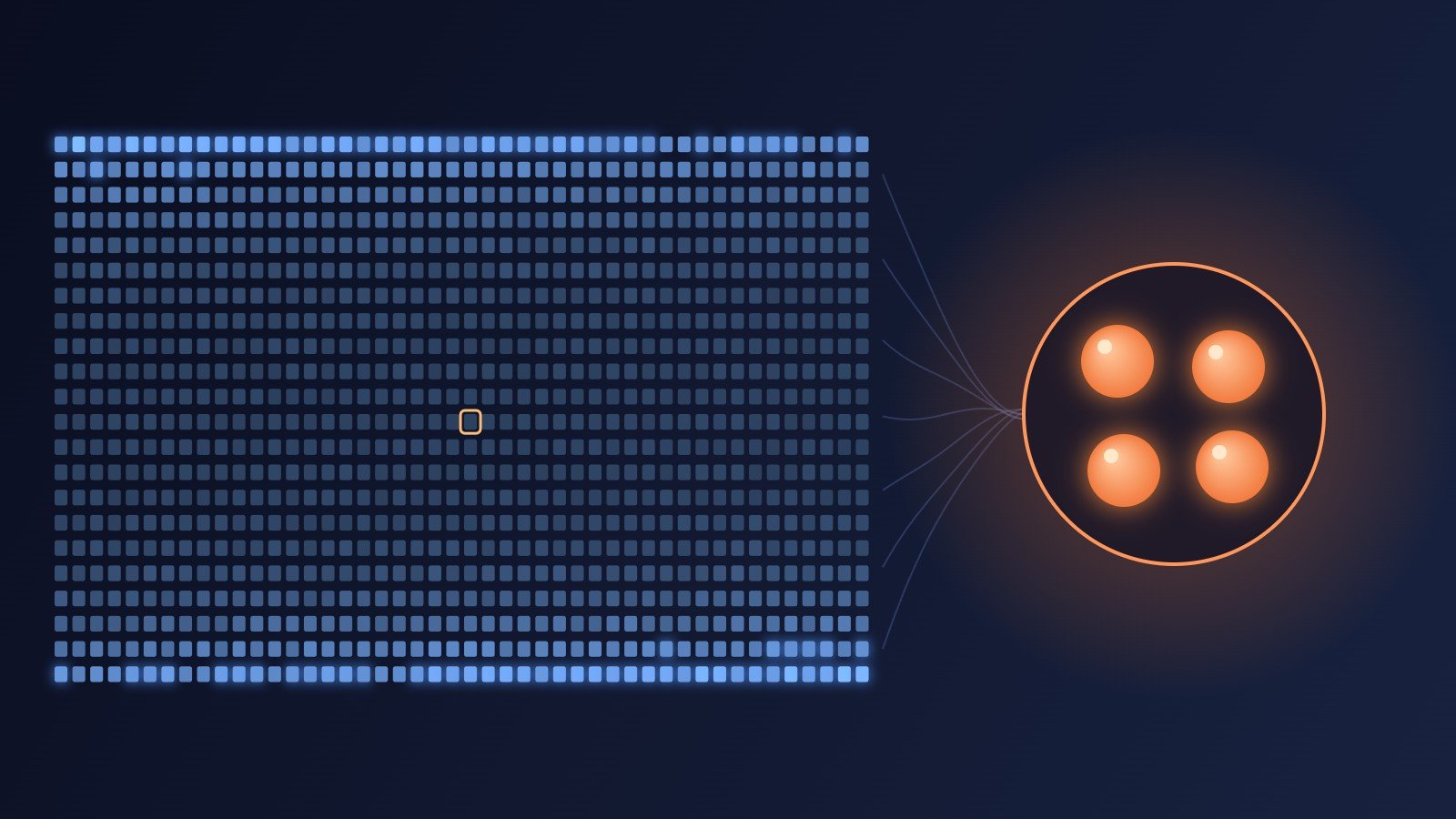
Read a phone number once and try to hold it in your head while someone talks to you. Most of us lose it within seconds. Now picture an AI reading a whole shelf of books in one go and answering questions about any page. It sounds like no contest. Yet hide one key sentence in the middle of a long report, and that same AI can miss it, in a way that looks oddly human.
A tiny bag and a giant table
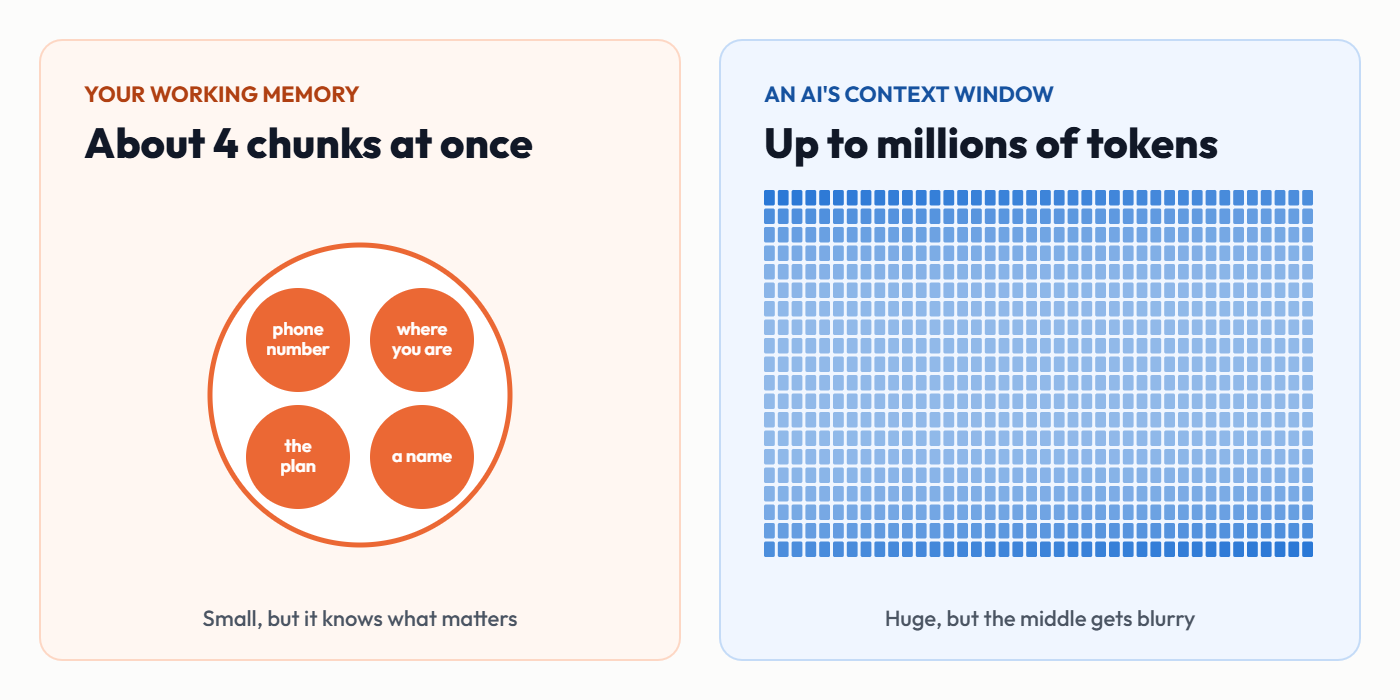
The famous old number for short-term memory was “seven, plus or minus two.” When psychologist Nelson Cowan reviewed the evidence in 2001, he put the real limit closer to three to five chunks. A chunk can be one letter or a whole idea, which is why chess masters can rebuild a board after a glance: they see patterns, not 25 separate pieces.
Working memory is also more than a box. In Alan Baddeley and Graham Hitch’s 1974 model, it is a small team led by a “central executive” that steers attention, and it constantly links what you hold now to what you already know. That link is its secret weapon: you do not just store information, you understand it.
AI plays on another scale. Google’s Gemini 1.5 report described a model finding details across millions of tokens, enough for dozens of novels. A mechanism called self-attention lets it compare every word with every other word at once.
Both forget the middle
Here is the surprise. In 1962, psychologist Bennet Murdock read people lists of words and asked them to recall as many as they could. They remembered the first and last words best and the middle worst, a pattern called the serial position effect.
Sixty years later, Stanford researchers hid one useful document among many in a long AI prompt and moved it around. The models did best when the key information came first or last, and clearly worse in the middle. They called it “lost in the middle” and noted the resemblance to Murdock’s curve themselves.
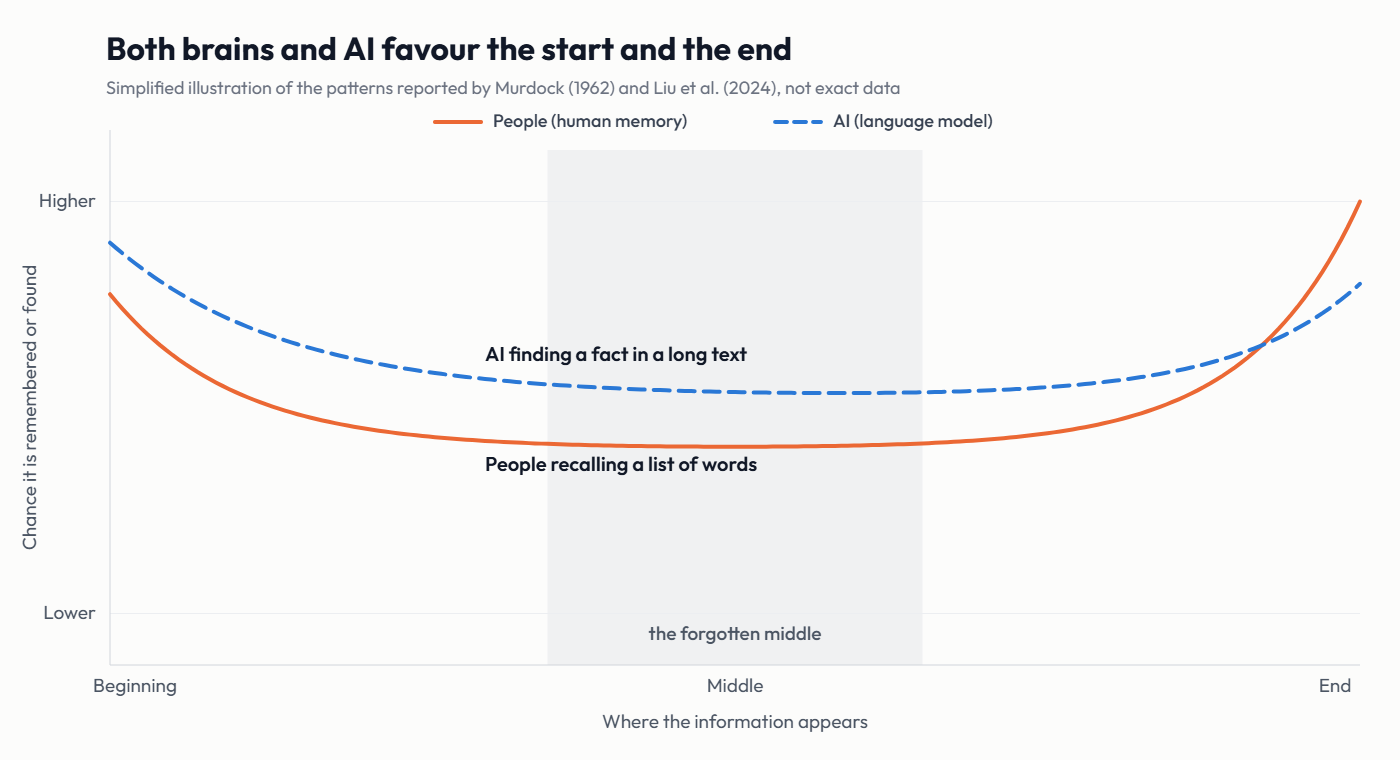
The causes differ. People remember early words because they rehearsed them, and late words because they are still in working memory. In AI, the dip seems to come from training: a 2025 study recreated the same curve by training small models on classic human memory tasks. And a test called RULER found that many models work well below their advertised window size on harder tasks.
Different ways of getting it wrong
Neither is a perfect recorder. Human memory rebuilds the past each time we recall it, and Elizabeth Loftus spent 30 years showing how a leading question can quietly change what people remember, even planting events that never happened. AI fails differently: it skips information right in front of it, or fills a gap with a confident answer that appears nowhere in the text.
Your memory is small, but it keeps what matters. An AI’s memory is huge, but it is wiped when the conversation ends.
What happens when the session ends
The biggest difference comes afterwards. With the help of the hippocampus, your brain turns fresh experiences into lasting memories, much of it while you sleep. You end each day with a slightly different brain.
Chatbots work another way. What a model knows long term was learned in training and stored in billions of connections called weights, and those do not change while you chat. It can learn from examples in the window, but nothing is saved into the model. Close the chat and the table is cleared. (Some apps keep separate notes about you, but that is a filing cabinet bolted on outside, not the model learning.)
Why not let AI learn on the fly? New learning tends to overwrite old knowledge, a problem called catastrophic forgetting. The brain seems to dodge it by splitting the job between a fast learner, the hippocampus, and a slow one, the cortex.
A Nobel-winning connection
The two worlds are closer than they look. In 1982, John Hopfield described a network that rebuilds a whole memory from a partial clue, the way a song comes back from its first few notes. That work helped earn him the 2024 Nobel Prize in Physics, shared with Geoffrey Hinton. In 2020, researchers showed that the attention inside today’s AI is mathematically a modern Hopfield network, and others found transformers producing patterns that resemble hippocampal cells. Nobody built them to copy the brain, yet they keep landing on similar solutions.
It is the same notepad that lets you down in the doorway effect, and the same handover to long-term memory that broke down for patient H.M. Attention’s blind spots show up in the invisible gorilla experiment too.
- Human working memory holds about 3 to 5 chunks; AI context windows can hold millions of tokens.
- Both remember the beginning and end of a long sequence better than the middle.
- The brain turns experiences into lasting memories; today’s chatbots forget a conversation once it ends.
So who wins? For holding a mountain of text at once, the AI is far ahead. For deciding what matters, linking it to everything you know and keeping it for life, the small bag in your head is still remarkable. So when a phone number vanishes after five seconds, go easy on yourself. Your brain is busy keeping the things that count.
Images: original illustrations by nnneuro. The memory-curve chart is a simplified illustration of published findings, not exact data.
References
- Miller GA. The magical number seven, plus or minus two: some limits on our capacity for processing information. Psychological Review. 1956;63(2):81–97.
- Cowan N. The magical number 4 in short-term memory: a reconsideration of mental storage capacity. Behavioral and Brain Sciences. 2001;24(1):87–114.
- Chase WG, Simon HA. Perception in chess. Cognitive Psychology. 1973;4(1):55–81.
- Baddeley AD, Hitch G. Working memory. In: Bower GH, editor. The Psychology of Learning and Motivation. Vol 8. New York: Academic Press; 1974. p. 47–89.
- Baddeley A. The episodic buffer: a new component of working memory? Trends in Cognitive Sciences. 2000;4(11):417–423.
- Tulving E. Elements of Episodic Memory. Oxford: Oxford University Press; 1983.
- Gemini Team, Google (Reid M, Savinov N, Teplyashin D, et al.). Gemini 1.5: unlocking multimodal understanding across millions of tokens of context. arXiv. 2024;2403.05530.
- Vaswani A, Shazeer N, Parmar N, Uszkoreit J, Jones L, Gomez AN, Kaiser Ł, Polosukhin I. Attention is all you need. Advances in Neural Information Processing Systems. 2017;30:5998–6008.
- Murdock BB. The serial position effect of free recall. Journal of Experimental Psychology. 1962;64(5):482–488.
- Liu NF, Lin K, Hewitt J, Paranjape A, Bevilacqua M, Petroni F, Liang P. Lost in the middle: how language models use long contexts. Transactions of the Association for Computational Linguistics. 2024;12:157–173.
- Salvatore N, Wang H, Zhang Q. Lost in the middle: an emergent property from information retrieval demands in LLMs. arXiv. 2025;2510.10276.
- Hsieh CP, Sun S, Kriman S, Acharya S, Rekesh D, Jia F, Zhang Y, Ginsburg B. RULER: what’s the real context size of your long-context language models? arXiv. 2024;2404.06654.
- Loftus EF. Planting misinformation in the human mind: a 30-year investigation of the malleability of memory. Learning & Memory. 2005;12(4):361–366.
- Squire LR. Memory and the hippocampus: a synthesis from findings with rats, monkeys, and humans. Psychological Review. 1992;99(2):195–231.
- McClelland JL, McNaughton BL, O’Reilly RC. Why there are complementary learning systems in the hippocampus and neocortex: insights from the successes and failures of connectionist models of learning and memory. Psychological Review. 1995;102(3):419–457.
- Brown TB, Mann B, Ryder N, et al. Language models are few-shot learners. Advances in Neural Information Processing Systems. 2020;33:1877–1901.
- Goodfellow I, Bengio Y, Courville A. Deep Learning. Cambridge, MA: MIT Press; 2016.
- Kirkpatrick J, Pascanu R, Rabinowitz N, et al. Overcoming catastrophic forgetting in neural networks. Proceedings of the National Academy of Sciences. 2017;114(13):3521–3526.
- Hopfield JJ. Neural networks and physical systems with emergent collective computational abilities. Proceedings of the National Academy of Sciences. 1982;79(8):2554–2558.
- The Royal Swedish Academy of Sciences. They used physics to find patterns in information. Popular science background, The Nobel Prize in Physics 2024. Stockholm: Nobel Prize Outreach; 2024.
- Ramsauer H, Schäfl B, Lehner J, et al. Hopfield networks is all you need. International Conference on Learning Representations (ICLR). 2021.
- Whittington JCR, Warren J, Behrens TEJ. Relating transformers to models and neural representations of the hippocampal formation. International Conference on Learning Representations (ICLR). 2022.
Every article is written in clear, jargon-free language and based on evidence from peer-reviewed research and established neuroscience references. We draw from review papers, textbooks, and leading scientific journals to explain complex topics accurately and accessibly. When important scientific evidence changes our understanding of a topic, we revise our content to reflect it.