
You hear a recording of yourself — a voicemail, a video — and you cringe. “Do I really sound like that?” To you it sounds thin, higher, somehow wrong. To everyone else, that is simply your voice. So why does your own recorded voice sound like a stranger’s?
The voice in your head has always had a secret ingredient that no one else, and no microphone, ever hears.
Two versions of your voice
Everyone else hears only the air-conducted version of your voice. A recording does the same. When you finally hear that version, it is missing all the deep tones your skull was quietly adding — so it sounds higher and thinner than the voice you have listened to your entire life. Your brain, expecting the richer version, flags the difference as “not me.”
Why it feels so jarring
Part of the discomfort is simple unfamiliarity, and part may be that our self-image includes how we think we sound. Hearing the “real” version can feel like seeing an unflattering photo — not wrong, just not the you that you carry around inside.
The voice in your head has a bass line only you can hear.
It is another example of the brain quietly shaping what we perceive, like the eyes changing what we hear in the McGurk effect, or a melody replaying itself as an earworm. For more, this overview of bone conduction is a good next step.
- You hear your own voice through both air and the bones of your skull.
- Bone conduction adds deep tones that recordings and other people miss.
- A recording sounds higher and thinner, so it feels unfamiliar and wrong.
The good news: the voice on the recording is the real, perfectly normal voice everyone else already knows and likes. It is only new to you — and, like most things, it stops sounding strange the more you hear it.
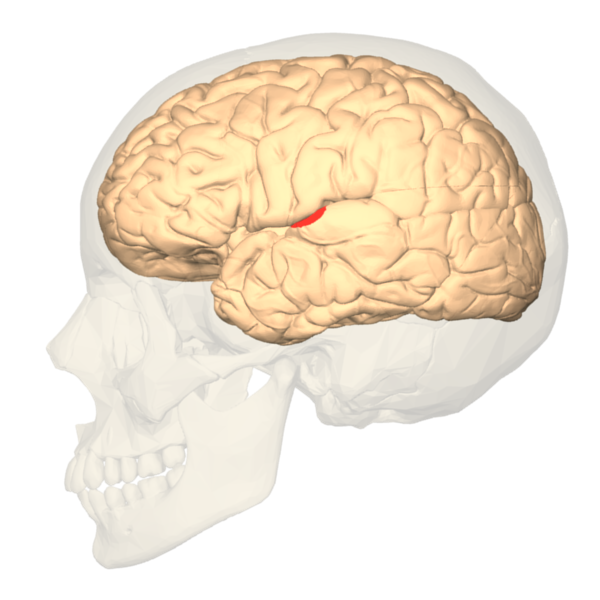
Images: studio microphone by Will Fisher (CC BY-SA 2.0) and auditory-cortex diagram by Anatomography (CC BY-SA 2.1 JP), via Wikimedia Commons.
References
- Maurer D, Landis T. Role of bone conduction in the self-perception of speech. Folia Phoniatrica. 1990;42(5):226–229.
- Shuster LI, Durrant JD. Toward a better understanding of the perception of self-produced speech. Journal of Communication Disorders. 2003;36(1):1–11.
Every article is written in clear, jargon-free language and based on evidence from peer-reviewed research and established neuroscience references. We draw from review papers, textbooks, and leading scientific journals to explain complex topics accurately and accessibly. When important scientific evidence changes our understanding of a topic, we revise our content to reflect it.