You have probably heard at least one of these: chess makes you smarter, grandmasters burn 6,000 calories a day just by thinking, and a game a day keeps dementia away. One of those is half true, one is unproven, and one was never measured at all. What really happens inside your head over a chessboard is stranger than any of them, and more useful to you.
Try this before you read on
Look at board A for five seconds. Then cover it and try to picture where everything was. Now do the same with board B.
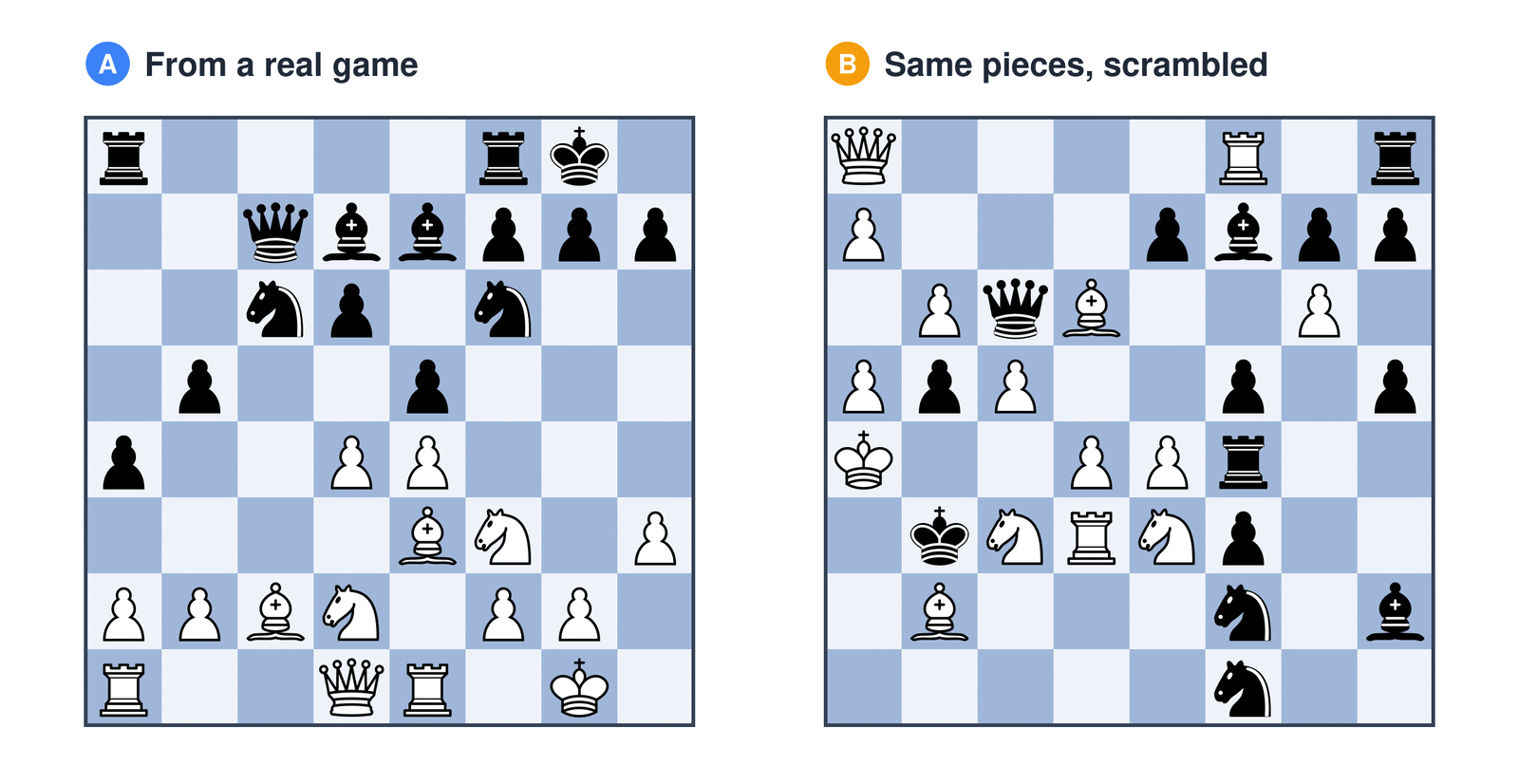
If you are new to chess, both probably felt hopeless. If you play a lot, board A felt oddly easy and board B felt exactly as hard as it does for everyone else. That small difference is the key to the whole story.
What a chess master really remembers
In the 1940s the Dutch psychologist (and chess master) Adriaan de Groot flashed positions at players for a few seconds and asked them to rebuild them. The strongest players were astonishingly good at it. In 1973, William Chase and Herbert Simon ran the test again with a master, a club player and a beginner, and added the twist you just tried: scrambled boards.
After a five-second look at a real position, the master placed about 16 pieces correctly on his first try, the club player about 8 and the beginner about 4. On scrambled boards the master’s gift vanished. All three did worse than the beginner had done on real games.
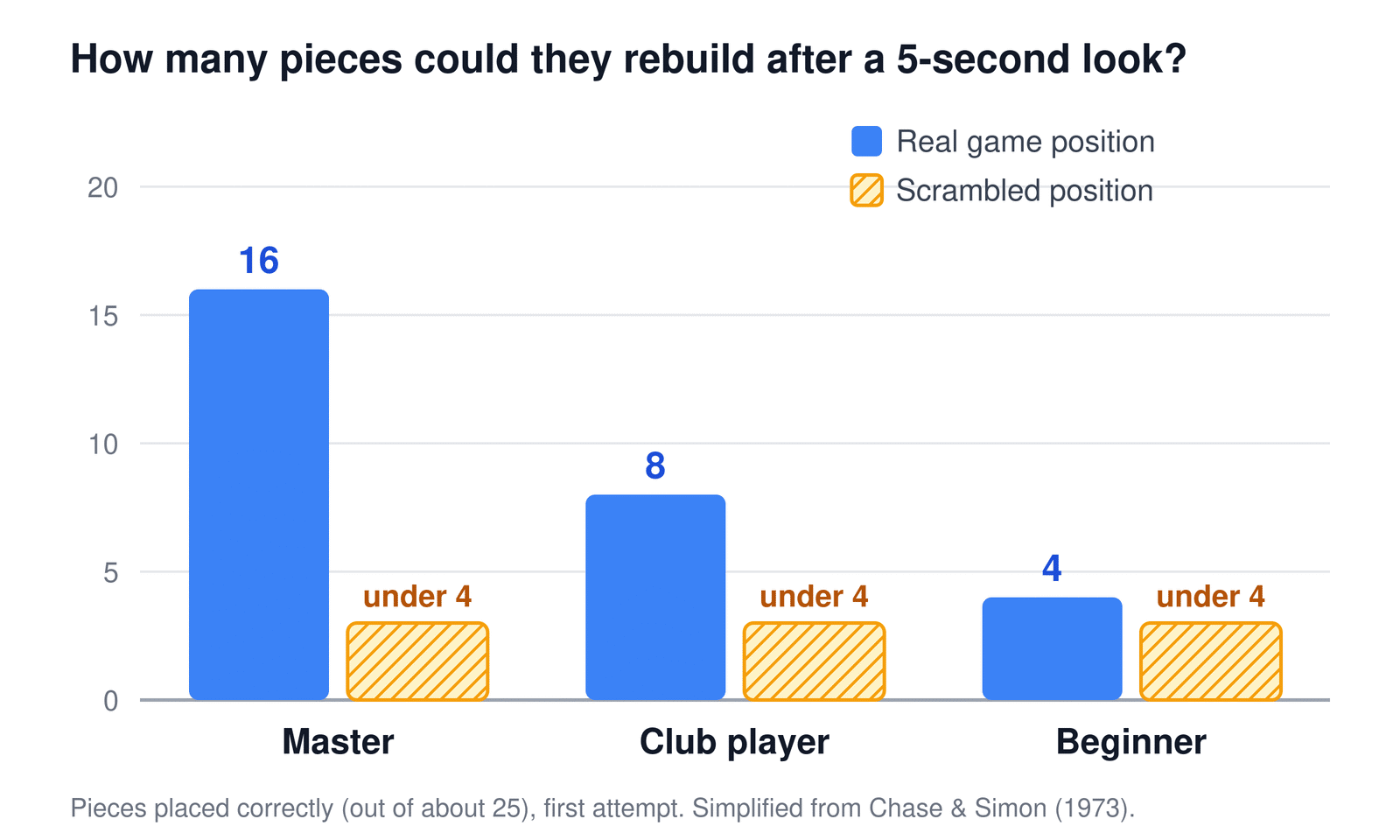
So a master’s memory is not better in general. It is better stocked. Where you see 25 loose pieces, a master sees five or six familiar groups, and Fernand Gobet and Herbert Simon later estimated that a master has around 50,000 such chunks stored away. (Later studies did find a small edge on random boards too, probably because experts still spot the odd familiar fragment.)
That stock is also why strong players can play fast. When a top grandmaster played several strong opponents at once, with far less thinking time per move than in a normal game, his level dropped only slightly. Most of his strength came from recognising what was in front of him, not from calculating further ahead.
Building the library takes time. In a survey of Argentinian players, one player reached a 2200 rating, roughly master level, after about 3,000 hours of practice. Another needed more than 23,000. Some who had put in over 25,000 hours never got there at all.
Where it happens in your brain
Brain scans add a strange detail. Merim Bilalić and his colleagues found that when experts look at chess positions, a patch of brain best known for recognising faces, the fusiform face area, becomes more active than it does in novices. An expert may take in a familiar position a bit like you take in a friend’s face: all at once, without checking each feature. Not every lab agrees. Another scanning study that year found the experts’ extra activity in nearby areas rather than in the face patch itself.
Experts and amateurs also seem to lean on different parts of the brain. When researchers in Germany recorded bursts of brain activity in people while they played, amateurs showed most of them deep in the medial temporal lobe, which handles fresh memories. Grandmasters showed more in the frontal and parietal cortex. That fits the idea that the expert pulls ready-made knowledge out of long-term storage while the amateur works each position out from scratch.
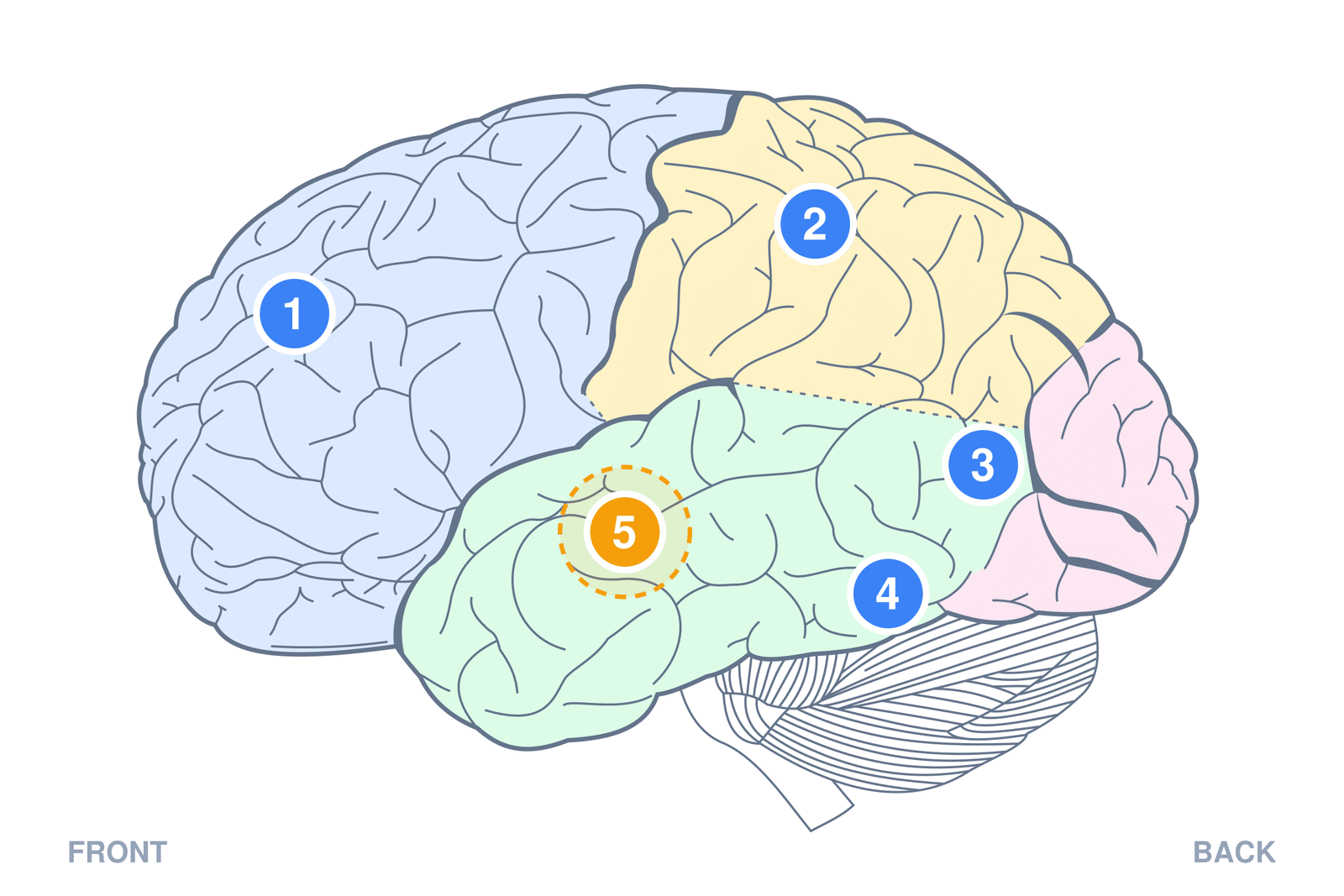
- Front (prefrontal cortex): planning, comparing options and stopping yourself from playing the first move you see.
- Top (parietal cortex): holding the board in your mind’s eye and imagining pieces moving. Grandmasters lean on it more.
- Where the temporal and parietal lobes meet: linked to thinking about other people’s minds. In one scanning study, simply choosing a chess move switched it on too, as if players were asking themselves what their opponent wanted.
- Underside, towards the back (fusiform area): recognising familiar shapes at a glance, faces included.
- Deep inside (medial temporal lobe, around the hippocampus): storing new information. Amateurs rely on it more.
Your body during a tense game
About those 6,000 calories: nobody ever measured them. The figure appears to be a rough guess built on breathing rates, and it spread from there. When researchers actually wired up 20 players during games, they found something real but modest. Heart rate rose, the nervous system tipped towards its stress mode, and the body slowly switched from burning sugar to burning fat. Chess is stressful. It is not a workout.
Your surroundings matter more than you might guess. Economists put air-quality sensors into the playing halls of German chess tournaments and checked more than 30,000 moves. On days with more fine dust in the air, players made more mistakes, and bigger ones, especially late in the game when the clock was running down. If you have ever blundered in a stuffy room in the last minutes of a game, it may not have been only nerves.
So does chess make you smarter?
This is the big one, and the honest answer is: probably not in the way people hope.
Clever people are a little more likely to be good at chess. A 2016 analysis that pooled 19 studies of almost 1,800 players found modest links between chess skill and reasoning, short-term memory and processing speed, strongest in children and in weaker players. That tells you who tends to get good at chess. It does not tell you what chess does to you.
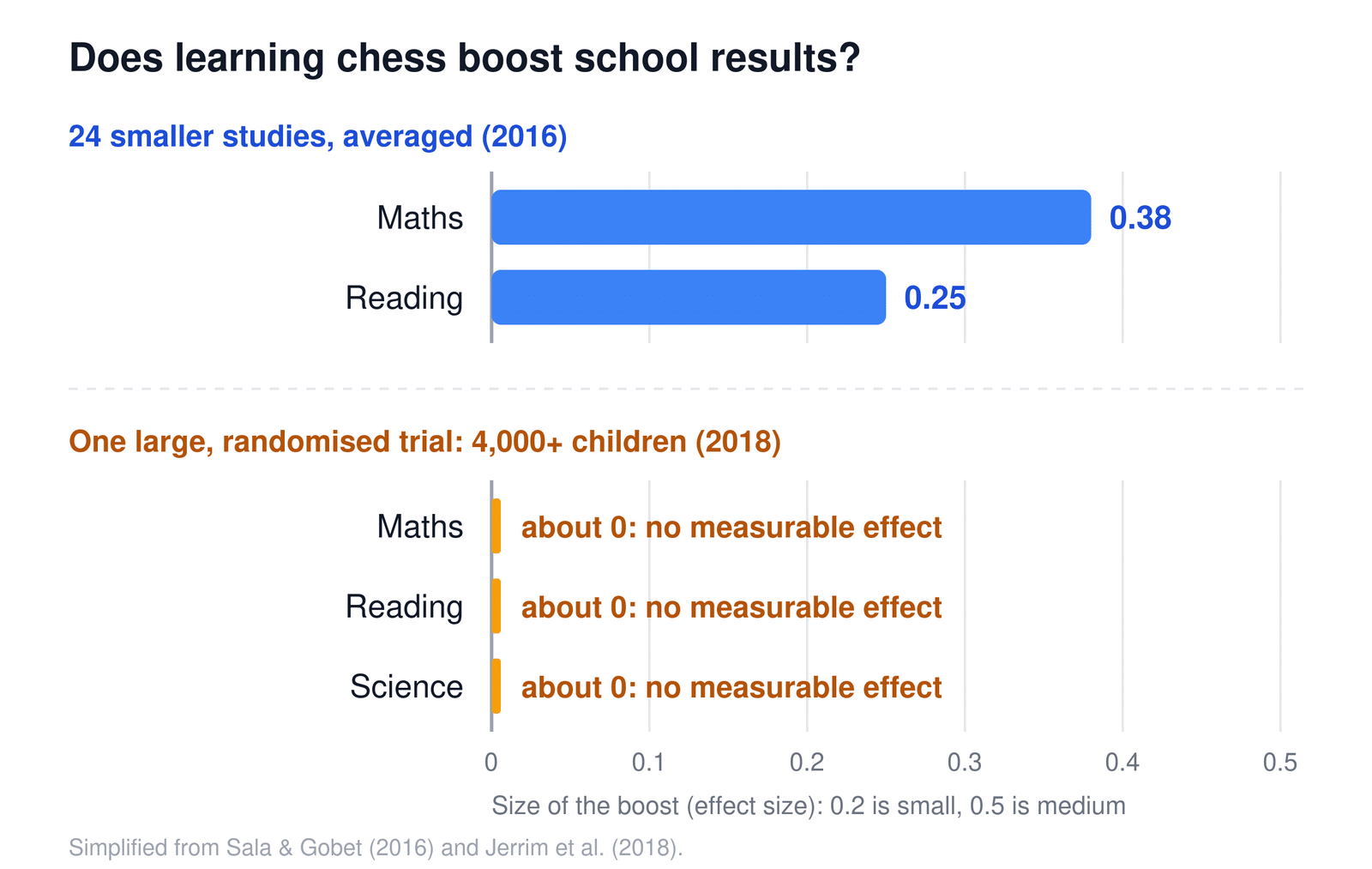
To test that, you have to teach chess to one group and compare them with a similar group that didn’t learn. Giovanni Sala and Fernand Gobet pooled 24 such studies with over 5,000 children and found modest gains, a little larger in maths than in reading. The catch is that most of those studies were small and almost none compared chess with another new activity, so the boost may have come from the extra attention and novelty. When the same researchers later looked at only the best-designed studies across chess, music and memory training, the effect on general abilities shrank to little or nothing.
Then came the big test. In England, more than 4,000 primary-school children were randomly assigned to a year of chess lessons or to carry on as usual. A year after the lessons ended, the chess group did no better in their national maths, reading or science tests.
Does chess change the brain physically?
A little, maybe. A team in Switzerland scanned 20 expert players, including three grandmasters, and 20 similar non-players. The differences were small: slightly thinner grey matter where vision meets pattern recognition, a difference in a white-matter pathway linking the front and back of the brain, and no area that was bigger in the players. A Chinese study of grandmasters and masters of Chinese chess found a smaller caudate, a deep structure involved in habits and fast, automatic choices, with stronger links between it and wider brain networks.
Smaller does not mean worse here. A brain that does one job thousands of times can get more efficient at it. But both studies took a single snapshot of people who already played, so they can’t tell whether chess shaped those brains or whether brains like that are drawn to chess.
What about dementia?
Here the news is more hopeful, with a big asterisk. In a New York study of 469 people aged 75 and over, those who played board games several times a week were much less likely to develop dementia over about five years than those who rarely played. A 2023 Australian study of more than 10,000 people over 70 found that mentally active pastimes such as puzzles, cards, chess and writing went with a 9 to 11 percent lower risk.
The asterisk: both studies show a link, not proof. People who keep playing tend to be healthier and better educated, and dementia starts years before anyone notices, so people in its early stages may simply stop playing. The researchers behind both studies said so themselves. Playing chess in old age is a lovely habit. Calling it a vaccine goes too far.
The trap every player falls into (and so do you)
One of the most useful findings from chess research has nothing to do with chess. In 2008, Bilalić, Peter McLeod and Gobet gave experts positions with a familiar winning plan and a shorter, stronger plan hidden beside it. Many found the familiar plan and stopped. They said they were still looking for something better, but eye-tracking showed their gaze kept drifting back to the squares of the plan they already had.
Psychologists call this the Einstellung effect: a good first idea blocks a better one. It catches doctors who stick with a first diagnosis, engineers who reuse an old fix, and anyone who has rewritten the same sentence ten times. Chess players have an old saying for it: when you see a good move, look for a better one.
A good first idea can block a better one. Strong players train themselves to look again.
Chunking is the same trick that lets your tiny working memory punch above its weight, as we explained in Your Brain vs. AI. And the habit of seeing only what you expect to see shows up in the invisible gorilla experiment too.
- After a five-second look, a master rebuilt about 16 pieces of a real position and a beginner about 4. On scrambled boards, nobody did well.
- Experts lean more on long-term memory and pattern-recognition areas, but the physical differences in their brains are small and their cause is unclear.
- Large, fair trials find little evidence that chess lessons raise intelligence or school results.
- Board games in later life go with a lower dementia risk, but that link is not proof.
- The 6,000-calorie claim is a myth. Stress, time pressure and stale air do make you blunder more.
So play chess because it is a beautiful game, because it teaches you to sit with a hard problem without panicking, and because it is more fun with a friend than any brain-training app. Just don’t expect it to make you a genius at everything else. And the next time you find a good move, on the board or anywhere else, stop and look for a better one.

Images: cover photo by Michał Parzuchowski (CC0), via Wikimedia Commons; brain outline adapted from Henry Vandyke Carter, Gray’s Anatomy (public domain), via Wikimedia Commons; chess pieces by Cburnett (CC BY-SA 3.0). Diagrams and charts by nnneuro. The charts are simplified illustrations of published findings, not exact data.
References
- de Groot AD. Thought and Choice in Chess. The Hague: Mouton; 1965.
- Chase WG, Simon HA. Perception in chess. Cognitive Psychology. 1973;4(1):55–81.
- Gobet F, Simon HA. Recall of random and distorted chess positions: implications for the theory of expertise. Memory & Cognition. 1996;24(4):493–503.
- Gobet F, Simon HA. The roles of recognition processes and look-ahead search in time-constrained expert problem solving: evidence from grand-master-level chess. Psychological Science. 1996;7(1):52–55.
- Gobet F, Campitelli G. The role of domain-specific practice, handedness, and starting age in chess. Developmental Psychology. 2007;43(1):159–172.
- Bilalić M, Langner R, Ulrich R, Grodd W. Many faces of expertise: fusiform face area in chess experts and novices. Journal of Neuroscience. 2011;31(28):10206–10214.
- Krawczyk DC, Boggan AL, McClelland MM, Bartlett JC. The neural organization of perception in chess experts. Neuroscience Letters. 2011;499(2):64–69.
- Amidzic O, Riehle HJ, Fehr T, Wienbruch C, Elbert T. Pattern of focal γ-bursts in chess players. Nature. 2001;412(6847):603.
- Powell JL, Grossi D, Corcoran R, Gobet F, García-Fiñana M. The neural correlates of theory of mind and their role during empathy and the game of chess: a functional magnetic resonance imaging study. Neuroscience. 2017;355:149–160.
- Troubat N, Fargeas-Gluck MA, Tulppo M, et al. The stress of chess players as a model to study the effects of psychological stimuli on physiological responses: an example of substrate oxidation and heart rate variability in man. European Journal of Applied Physiology. 2009;105:343–349.
- Künn S, Palacios J, Pestel N. Indoor air quality and strategic decision making. Management Science. 2023;69(9):5354–5377.
- Burgoyne AP, Sala G, Gobet F, Macnamara BN, Campitelli G, Hambrick DZ. The relationship between cognitive ability and chess skill: a comprehensive meta-analysis. Intelligence. 2016;59:72–83.
- Sala G, Gobet F. Do the benefits of chess instruction transfer to academic and cognitive skills? A meta-analysis. Educational Research Review. 2016;18:46–57.
- Sala G, Gobet F. Does far transfer exist? Negative evidence from chess, music, and working memory training. Current Directions in Psychological Science. 2017;26(6):515–520.
- Jerrim J, Macmillan L, Micklewright J, Sawtell M, Wiggins M. Does teaching children how to play cognitively demanding games improve their educational attainment? Evidence from a randomized controlled trial of chess instruction in England. Journal of Human Resources. 2018;53(4):993–1021.
- Hänggi J, Brütsch K, Siegel AM, Jäncke L. The architecture of the chess player’s brain. Neuropsychologia. 2014;62:152–162.
- Duan X, He S, Liao W, Liang D, Qiu L, Wei L, Li Y, Liu C, Gong Q, Chen H. Reduced caudate volume and enhanced striatal-DMN integration in chess experts. NeuroImage. 2012;60(2):1280–1286.
- Verghese J, Lipton RB, Katz MJ, Hall CB, Derby CA, Kuslansky G, Ambrose AF, Sliwinski M, Buschke H. Leisure activities and the risk of dementia in the elderly. New England Journal of Medicine. 2003;348(25):2508–2516.
- Wu Z, Pandigama DH, Wrigglesworth J, et al. Lifestyle enrichment in later life and its association with dementia risk. JAMA Network Open. 2023;6(7):e2323690.
- Bilalić M, McLeod P, Gobet F. Why good thoughts block better ones: the mechanism of the pernicious Einstellung (set) effect. Cognition. 2008;108(3):652–661.
Every article is written in clear, jargon-free language and based on evidence from peer-reviewed research and established neuroscience references. We draw from review papers, textbooks, and leading scientific journals to explain complex topics accurately and accessibly. When important scientific evidence changes our understanding of a topic, we revise our content to reflect it.