
A power outlet looks shocked. The front of a car seems to grin at you. A face peers out of the clouds, the moon, or a slice of toast. Your brain finds faces everywhere — even where there are none at all. This is pareidolia.
Two dots and a line below them, and you cannot help it: you see a face, and often even read an expression on it. The effect is instant and involuntary.
Why a trigger-happy face detector helps
Faces mattered enormously to our ancestors — friend or foe, parent or predator. A brain that occasionally sees a face in a shadow loses little; a brain that misses a real face could lose everything. Evolution tuned the system to be quick and generous, and pareidolia is the harmless overspill.
More than a bit of fun
Pareidolia is behind the “man in the moon,” faces on Mars, and figures glimpsed in wallpaper. It also shows how much our perception is a two-way street: the brain does not just receive the world, it actively predicts and completes it, sometimes seeing more than is there.
Better to see one face too many than to miss the one that mattered.
It is the flip side of face blindness, where the face system fails, and a cousin of other perceptual quirks like déjà vu. For more, this overview of pareidolia is a good next step.
- Pareidolia is seeing faces and patterns in random things.
- It comes from a brain finely tuned, and quick, to detect faces.
- Seeing a false face is a small price for never missing a real one.
So when your car looks cheerful or a cloud seems to smile, that is not your imagination running wild — it is one of the oldest, most useful settings in your brain, gently overshooting. Faces matter so much that we are built to find them, even where there are none.
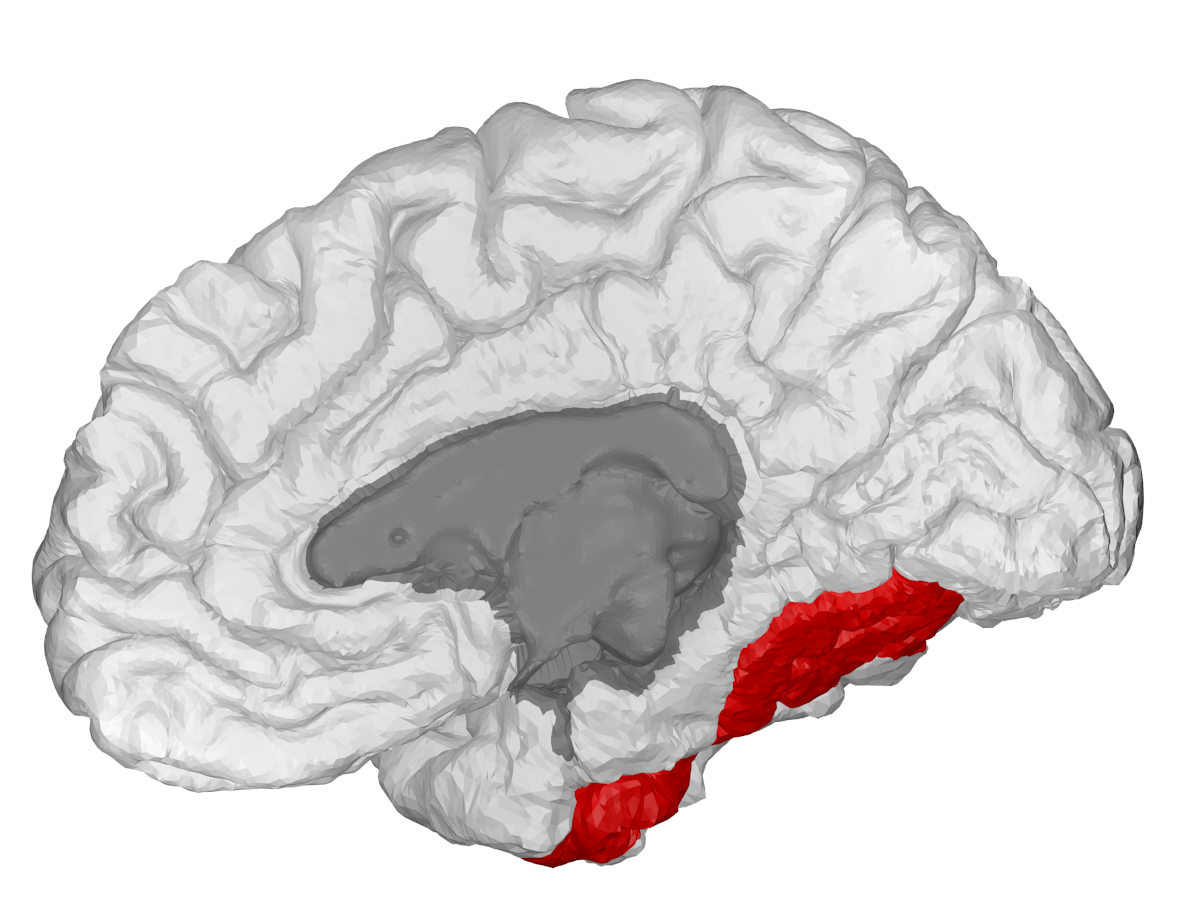
Images: a face seen in a fence post by Jemimah15 (CC BY-SA 4.0) and fusiform-gyrus diagram by R. V. Marinescu (CC BY 4.0), via Wikimedia Commons.
References
- Liu J, et al. Seeing Jesus in toast: neural and behavioral correlates of face pareidolia. Cortex. 2014;53:60–77.
- Palmer CJ, Clifford CWG. Face pareidolia recruits mechanisms for detecting human social attention. Psychological Science. 2020;31(8):1001–1012.
Every article is written in clear, jargon-free language and based on evidence from peer-reviewed research and established neuroscience references. We draw from review papers, textbooks, and leading scientific journals to explain complex topics accurately and accessibly. When important scientific evidence changes our understanding of a topic, we revise our content to reflect it.