
You learn a new word, and suddenly it is everywhere — in books, in conversations, on signs. You think about buying a certain car, and now that exact car is on every street. The world did not change. Your attention did. This is the frequency illusion, also known as the Baader–Meinhof phenomenon.
It feels almost spooky, as if the universe took the hint. But the surge is happening inside your head, not out in the world.
Two everyday biases, working together
Before you learned the word, your brain filtered it out as unimportant background. The moment it becomes meaningful, the filter flips and every instance jumps out. Because you do not remember all the times it appeared before, the new visibility feels like a real increase.
Why it matters
The frequency illusion is a gentle reminder that our sense of “how often” is unreliable, shaped by what we happen to notice. It can mislead us — making a rare risk feel common once it is on our minds, or convincing us a coincidence is a pattern. Knowing about it helps us trust our impressions a little less.
The world did not fill up with red cars. Your attention did.
It is a close relative of how focused attention hides an obvious event in the invisible gorilla, and of the brain’s pattern-hunting in déjà vu. For more, this overview of the frequency illusion is a good next step.
- The frequency illusion makes a newly noticed thing seem suddenly everywhere.
- It comes from selective attention plus a sense of confirmed pattern.
- Nothing got more common — your brain just started noticing it.
So the next time a new word or car seems to be following you around, enjoy the moment — then remember it is a quirk of attention, not a message from the cosmos. Your brain simply switched on a spotlight, and the world it revealed was there all along.
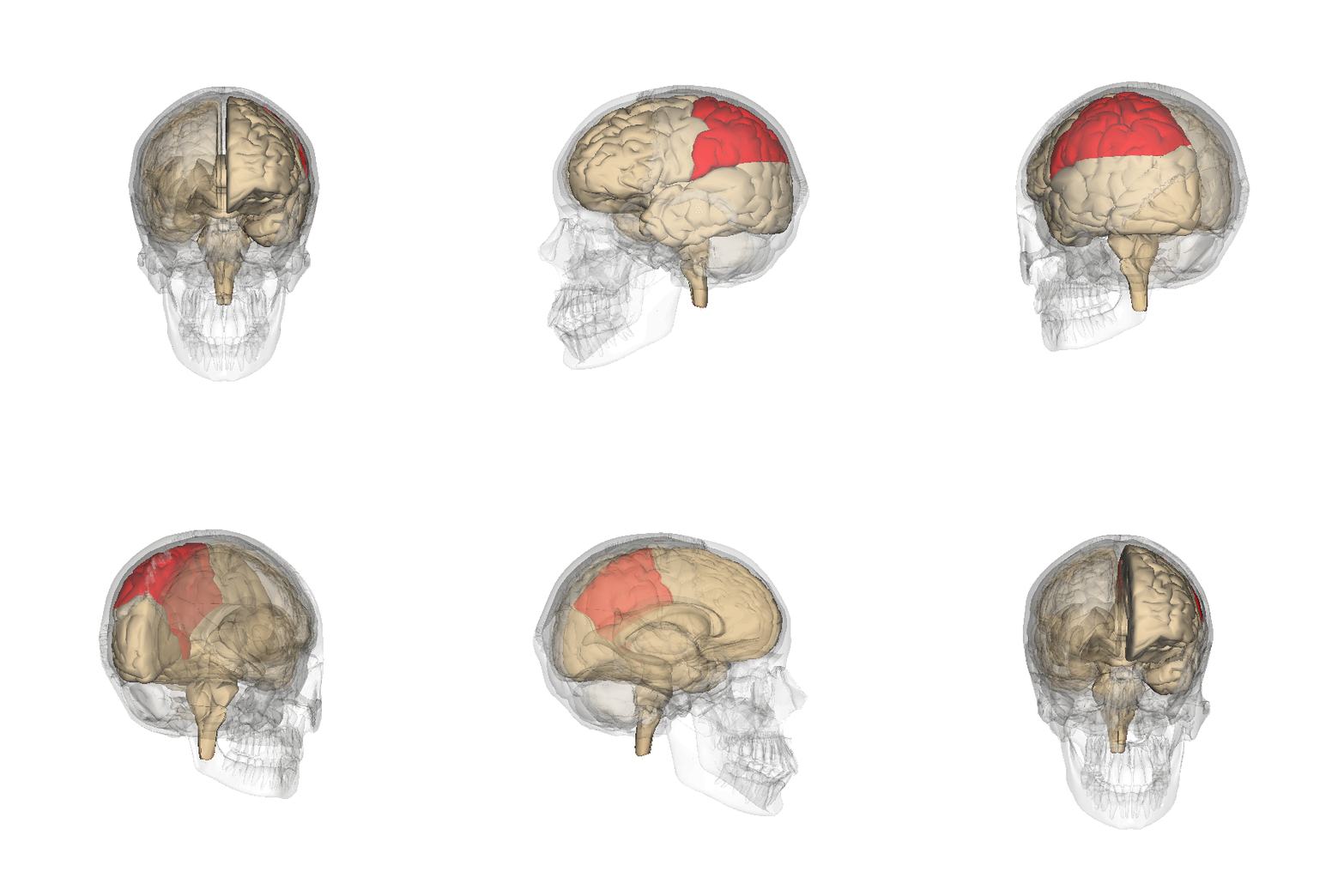
Images: red car on a city street by Hha Ting Tong (CC0) and parietal-lobe diagram by Anatomography (CC BY-SA 2.1 JP), via Wikimedia Commons.
References
- Zwicky A. Just between Dr. Language and I. Language Log. 2005 (coining of “frequency illusion”).
- Tversky A, Kahneman D. Availability: a heuristic for judging frequency and probability. Cognitive Psychology. 1973;5(2):207–232.
Every article is written in clear, jargon-free language and based on evidence from peer-reviewed research and established neuroscience references. We draw from review papers, textbooks, and leading scientific journals to explain complex topics accurately and accessibly. When important scientific evidence changes our understanding of a topic, we revise our content to reflect it.